




Hey there! As a supplier of Milling Flying Saws, I often get asked about the cutting capacity in terms of volume per hour. It's a crucial question for anyone in the industry, whether you're a manufacturer looking to boost production or a business owner aiming to optimize efficiency. So, let's dive right in and explore this topic in detail.
Understanding the Basics of Milling Flying Saws
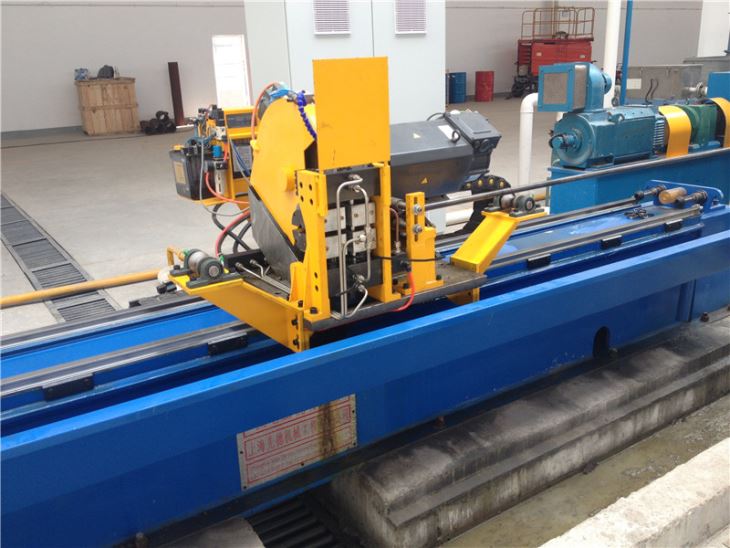
Before we get into the cutting capacity, let's quickly go over what a Milling Flying Saw is. A Milling Flying Saw is a high - speed cutting machine used in the metalworking industry, especially for cutting tubes and profiles. It can make precise cuts while the workpiece is in motion, which is a huge advantage as it allows for continuous production.
There are different types of saws related to the tube - making process. For example, the Tube Mill Cutting Machine is a versatile machine that can handle various tube sizes and materials. The Friction Saw uses friction to cut through metal, and the Computer Cold Flying Saw offers cold cutting, which is great for maintaining the integrity of the material.
Factors Affecting the Cutting Capacity
The cutting capacity of a Milling Flying Saw in terms of volume per hour depends on several factors.
Material Type
Different materials have different hardness and properties. For instance, cutting through aluminum is much easier than cutting through stainless steel. Aluminum is a softer metal, so the saw can cut through it faster, increasing the cutting volume per hour. On the other hand, stainless steel is harder and more abrasive, which slows down the cutting process and reduces the cutting capacity.
Tube or Profile Dimensions
The size and shape of the tube or profile being cut also play a significant role. Larger diameter tubes or thicker - walled profiles require more time and power to cut. A Milling Flying Saw may be able to cut a large number of small - diameter tubes in an hour, but when it comes to large - diameter tubes, the number of cuts per hour will be lower. For example, cutting a 1 - inch diameter tube will be quicker than cutting a 6 - inch diameter tube.
Saw Blade Quality and Speed
The quality of the saw blade is crucial. A high - quality saw blade can cut more efficiently and last longer. It can maintain a sharp edge for a longer period, which means it can make clean and fast cuts. The speed of the saw blade also matters. A faster - rotating saw blade can cut through the material more quickly, but it also needs to be balanced with the material and the machine's capabilities. If the blade rotates too fast, it may cause excessive wear and tear or even damage the material.
Machine Design and Automation
Modern Milling Flying Saws come with advanced automation features. Automated feeding, positioning, and cutting systems can significantly increase the cutting capacity. These systems can reduce the time between cuts by quickly moving the workpiece into position and starting the next cut. For example, a fully automated machine can make cuts in a continuous and efficient manner, without the need for manual intervention between each cut.

Calculating the Cutting Capacity
To calculate the cutting capacity in terms of volume per hour, we need to consider the following steps.
First, we need to determine the cross - sectional area of the tube or profile being cut. For a circular tube, the cross - sectional area (A) can be calculated using the formula (A=\pi\times((D/2)^2-(d/2)^2)), where D is the outer diameter and d is the inner diameter. For a rectangular profile, the area is simply the product of the length and width.
Next, we need to find out the length of the cut and the time it takes to make that cut. The cutting speed of the saw is usually given in meters per minute. Let's say the cutting speed is (v) meters per minute, and the length of the cut is (L) meters. The time taken to make one cut ((t)) can be calculated as (t = L/v) minutes.
Then, we need to consider the number of cuts per hour. If the machine can make (n) cuts per hour, the total length of material cut in an hour ((L_{total})) is (L_{total}=n\times L) meters.
Finally, the cutting capacity in terms of volume per hour ((V)) is the product of the cross - sectional area ((A)) and the total length of material cut in an hour ((L_{total})). So, (V = A\times L_{total}).
Let's take an example. Suppose we are cutting a circular tube with an outer diameter of 50 mm and a wall thickness of 2 mm. The cross - sectional area (A=\pi\times((0.05/2)^2-(0.046/2)^2)\approx 0.000295) square meters. If the cutting speed is 20 meters per minute, and the length of the cut is 1 meter, the time taken to make one cut is (t = 1/20 = 0.05) minutes. If the machine can make 120 cuts per hour, the total length of material cut in an hour is (L_{total}=120\times1 = 120) meters. The cutting capacity in terms of volume per hour is (V=0.000295\times120 = 0.0354) cubic meters per hour.
Real - World Examples
In a real - world scenario, a small - scale manufacturer using a basic Milling Flying Saw to cut 1 - inch diameter, thin - walled aluminum tubes may be able to achieve a cutting capacity of around 0.1 - 0.2 cubic meters per hour. This is because the small size and soft material allow for relatively fast cutting.
On the other hand, a large - scale industrial plant using a high - end, fully automated Milling Flying Saw to cut 4 - inch diameter stainless steel tubes may have a cutting capacity of 0.05 - 0.1 cubic meters per hour. The larger size and harder material slow down the cutting process, but the advanced automation features help to increase the efficiency as much as possible.
Improving the Cutting Capacity
If you want to improve the cutting capacity of your Milling Flying Saw, here are some tips.
- Upgrade the Saw Blade: Invest in high - quality saw blades that are designed for the specific material you are cutting. A good saw blade can make a significant difference in cutting speed and quality.
- Optimize the Machine Settings: Adjust the saw blade speed, feed rate, and other settings according to the material and the tube dimensions. This can help to achieve the most efficient cutting process.
- Implement Automation: If your machine is not fully automated, consider adding automation features. Automated feeding and positioning systems can reduce the time between cuts and increase the overall cutting capacity.
- Regular Maintenance: Keep the machine and the saw blade well - maintained. Regularly clean the machine, lubricate the moving parts, and replace the saw blade when it becomes dull. This can ensure that the machine operates at its best performance.
Conclusion
The cutting capacity of a Milling Flying Saw in terms of volume per hour is affected by various factors such as material type, tube or profile dimensions, saw blade quality and speed, and machine design and automation. By understanding these factors and making the necessary adjustments, you can optimize the cutting capacity of your Milling Flying Saw.
If you're in the market for a Milling Flying Saw or want to improve the performance of your existing machine, I'd love to have a chat. We can discuss your specific requirements and find the best solution for your business. Whether you're looking for a high - capacity machine for large - scale production or a more cost - effective option for small - scale operations, we've got you covered. So, don't hesitate to reach out and start the conversation about how we can help you boost your production efficiency.
References
- Machinery's Handbook: A comprehensive reference book on mechanical engineering and manufacturing processes, which provides detailed information on cutting tools and machine operations.
- Industry - specific trade magazines and journals that cover the latest developments in metalworking and tube - cutting technology.