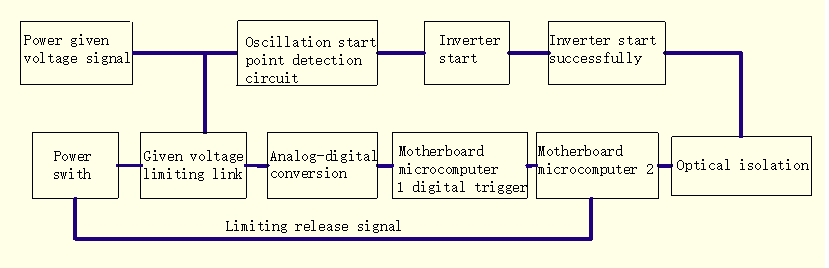
Due to great change in load, the startup of power source is particularly crucial. The startup modes include separate excitation toself-excitation, zero-pressure start-up, frequency sweeping startup, etc. The equipment adopts frequency sweeping startup mode, which has the advantages of wide operating frequency scope greater than 100KHZ. In the startup mode, the company's original frequency sweeping start circuit is used, which is controlled jointly by rectifier board and inverter board. The success rate of startup is high. The high voltage start is achieved in the event of full range adjustment of potentiometer, that is, when the potentiometer is adjusted to the maximum, it is viable to directly press the heating start button to make the voltage rise from 0 to full voltage. It is called full load start. The specific block diagram is as follows:
The fundamental principle of the frequency sweeping startup is to open the DC voltage to a certain value of about 20V, maintain it and then gradually increase the operating frequency of the inverter from the lowest frequency (lowest frequency can be set) until the suitable operating frequency (the frequency is close to the natural frequency of the tank circuit) is found. At this time, the inverter board sends a signal to the rectifier board (also known as the motherboard), the rectifier board then issues a limit release signal to release the limitation on the given voltage, such that the voltage can be increased from low voltage to full voltage. It is aimed to ensure the success rate of start and to avoid the inverter circuit from being the frequency sweeping process when the DC voltage is extremely high. At this moment, the inverter circuit has a poor operating status, thus preventing damage to the MOS elements in the startup process.